
Microscope
OpenFlexure Microscope
Experience lab-quality microscopy with our open-source microscope.
Build a Microscope
A guide to printing and assembling an OpenFlexure Microscope.
Buy a Microscope
Buy a microscope or kit from a vendor near you.
Install the Software
Download and install software to control your microscope.
Use your Microscope
Get started using your microscope.
 Microscopy for everyone
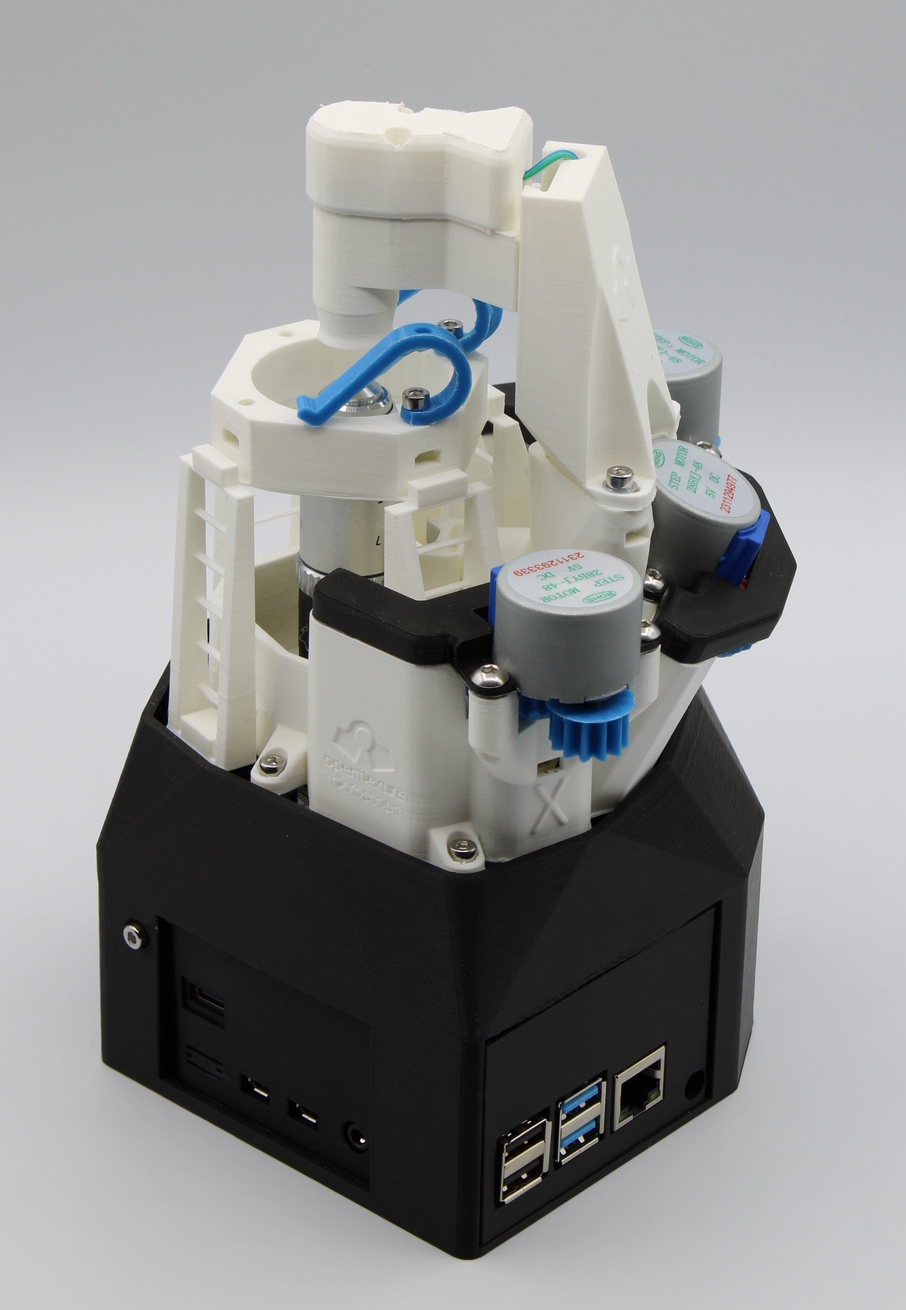
The OpenFlexure Microscope is a customisable, open-source optical microscope. It can be built using either low-cost webcam optics or laboratory-grade RMS-threaded microscope objectives. The system uses an inverted optical geometry and a high-precision mechanical stage, which can be motorised using low-cost geared stepper motors.
An overview of the OpenFlexure Microscope v6.0.0 is published in Biomedical Optics Express.
You can also explore academic publications from the OpenFlexure Project, or read media coverage for a more accessible introduction to the project.
High-performance, low-cost
Optomechanics is a crucial part of any microscope; when working at high magnification, it is absolutely crucial to keep the sample steady and to be able to bring it into focus precisely. Accurate motion control is extremely difficult using printed mechanical parts, as good linear motion typically requires tight tolerances and a smooth surface finish.
This design for a 3D printed microscope stage uses plastic flexures, meaning its motion is free from friction and vibration. It achieves steps well below 100 nanometers when driven with miniature stepper motors, and is stable to within a few microns over several days.
Easy to source, quick to assemble
This design aims to minimise both the amount of post-print assembly required, and the number of non-printed parts required - partly to make it as easy as possible to print, and partly to maximise stability; most of the microscope (including all the parts with flexures) prints as a single piece.
The majority of the expense is in the Raspberry Pi and its camera module; the design requires only around 200g of plastic and a few nuts, bolts and other parts.
Lab-ready customisation
The optics module (containing the camera and lens) can be easily swapped out or modified, for example to change the magnification/resolution by using a microscope objective.
Optional filter cubes can be printed, allowing for reflection (epi-) illumination, polarisation-contrast microscopy, and even fluorescence imaging.
